You have probably heard the term “Nose Blind” before. Nose blindness (also known as olfactory fatigue) is a temporary loss of sensitivity to a particular smell. After repeated exposure to the same scent, your olfactory receptors become less responsive, so your brain stops registering the odor—even though it’s still present.
This happens with every team member, manager, and executive who has been with an organization for any length of time. What once “smelled” when they first arrived at the organization, shifts to the back of their mind as “normal” as those processes, procedures, or habits of the organization become a normal part of their every day environment.
How "Normal" Gets Manufactured
There's a concept from organizational sociology that every leader should have in their vocabulary: normalization of deviance. Diane Vaughan coined it while studying the Challenger disaster, and her finding was not that NASA engineers were reckless or incompetent. It was something far more unsettling.
The O-ring erosion that eventually destroyed the shuttle had shown up on earlier flights. Each time it appeared and nothing catastrophic happened, the organization absorbed it. The anomaly got folded into the acceptable range. The bar for "normal" moved a quarter inch, then another quarter inch, and each individual step was defensible by itself. No one made a single bad decision. A culture made hundreds of small, reasonable-sounding ones, and the cumulative drift was invisible from the inside because everyone inside had drifted with it.
That's not a NASA problem. That's a human problem. Habituation is one of the most basic and reliable properties of the nervous system: repeated exposure to an unchanging stimulus reduces the response to it. Your brain is built to stop spending attention on things that don't change.
Which means the value of a fresh perspective is not a soft, nice-to-have thing. It's a hard, expiring asset. A new employee is the only person in the building running an uncalibrated instrument — and the calibration starts the moment they walk in.
The Conversation That Runs Backward
Here's what a normal ninety-day check-in looks like: a manager sits down with a new hire and evaluates how the new hire is doing. Are they ramping up? Are they hitting milestones? Any concerns? It's a reasonable meeting. It's also pointed in exactly the wrong direction at exactly the moment when the information is flowing the other way.
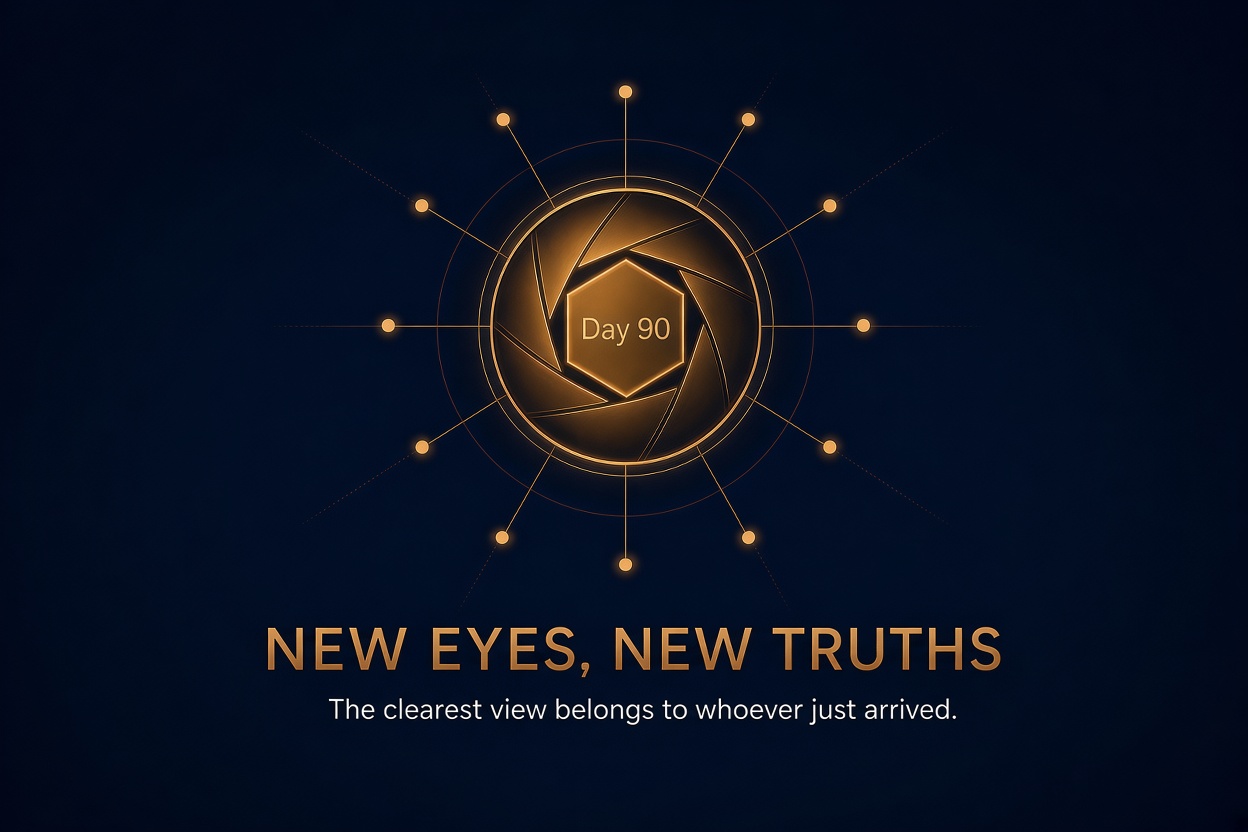
The alternative is a conversation I've come to think of as running backward — where the employee evaluates the organization. Ninety days is the specific and non-arbitrary window for it. It's long enough that they've seen how work actually moves, where the real decisions get made, which processes are theater and which ones matter. And it's short enough that they haven't gone “Nose Blind” to any of it yet. At Boaz Strategic, we call this the “New Eyes, New Truths” exercise.
Three questions do most of the work.
"Tell me about you — what do you actually enjoy doing?" Ninety days in, you know the worker. You've seen the output, the work habits, the meeting behavior. This is where you meet the person. And it isn't a warm-up question — it's a strengths question. It's how you find out that the analyst you hired lights up doing client-facing work, or that your quietest hire has run three volunteer organizations. That information has a shelf life too. People stop volunteering it once they've concluded that nobody is interested enough to ask about it.
"Are we living up to our values?" They arrived holding your promises — the ones from the careers page, the interview, and the employment offer conversation. They are the only people in the building who can tell you the gap between what you advertised and what you delivered, because they still remember the advertisement clearly. Everyone else has had years to quietly reconcile the two.
"What could we do better?" This is the one with the tightest expiration date. Right now they can still see the processes that can only be justified as “that’s just how it’s done”. Ask the same questions a few months later and you'll get "I can't think of anything," and they won't be lying to you. They'll have adapted.
The Invitation
So here's the question I'd put to any leader reading this: who in your organization is at day sixty right now, and what do they see that you no longer can?
This is exactly the thinking that Boaz Strategic builds executive coaching and workshops around: helping you hear what your newest people can still see, and helping you place your existing people where their strengths, passions, and roles point in the same direction. The goal is simple — pay people to be themselves, in the roles where they're most capable, most productive, and most fulfilled.
An organization that can still see itself clearly is one that can still change. And the people best equipped to hold up that mirror are the ones who just walked through your door.
We encourage you to download the “New Eyes, New Truths” Leadership Insight PDF and consider pairing this exercise with the “Engagement Pulse” Leadership Insight PDF for existing employees.
You can find both of these Leadership Insights on our Free Resources Center at https://boazstrategic.com/resources
Aaron D. Minard
Aaron D. Minard is a Faith Driven Executive Advisor and co-founder of Boaz Strategic, where he turns the complexity of leadership into simple actionable steps.
Ready to take the next step?
Build something that matters.
Begin your journey with Boaz Strategic.
Start Onboarding